Risk and controls
Verify disposal or return of personal data
Execute and evidence a scheduled or event driven deletion, anonymisation, return or suppression, confirmed across the systems, the processors and the copies.
A retention period expiring is only useful if something happens when it does. When a customer record reaches the end of its retention period at a telecoms provider, a privacy action is raised automatically, and closing that action properly means confirming disposal across every system and every processor holding a copy, not just the primary database.
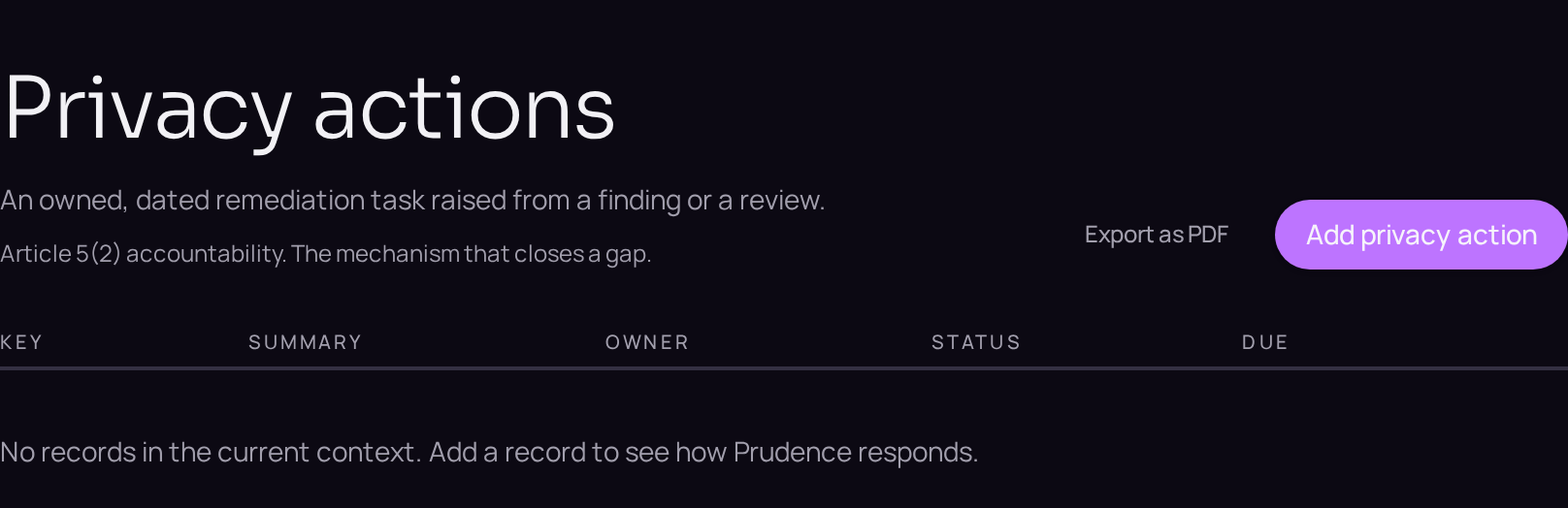
This is exercised whenever such an action lands in the privacy actions register, whether raised by the schedule or by an individual's erasure request.
The proof is that the action cannot be closed without evidence attached, and that the audit trail names who confirmed disposal and when.
- Regulation
- Articles 5(1)(e), 17 and 28
- Registers
- Privacy action · Retention schedule · System or asset · Entity · Agreement
The steps
- 01Open the Privacy actions register and select the action raised by the schedule.
- 02Open the Linked records band and read the systems the underlying activity holds data in.
- 03For each system, record confirmation of the clearance on the Details tab.
- 04For each processor involved, record the confirmation received from them.
- 05Attach the evidence, such as a deletion certificate, to the Evidence tab.
- 06Move the action from Open to Closed on the lifecycle bar.
Accepted when
- An action closed with no evidence is reported.
- The audit trail holds who confirmed the disposal and when.
Documents that carry the evidence
- RET · Retention and disposal schedule
- Retention rules by activity, category and legal requirement, with the disposal method for each. Article 5(1)(e).
- DPA · Data processing agreement
- The processor contract, with the instructions, confidentiality, security, subprocessing, assistance, return and audit terms Article 28(3) requires.
These templates are issued when the register opens, so the document exists before the record that cites it.